
Dental Surgery
Wisdom-tooth removal, sinus lifting and bone grafting — planned with CBCT imaging, performed with minimally invasive technique.
- Comprehensive Assessment
- Digital Imaging When Needed
- Personalized Treatment Plan
- Transparent Recommendations
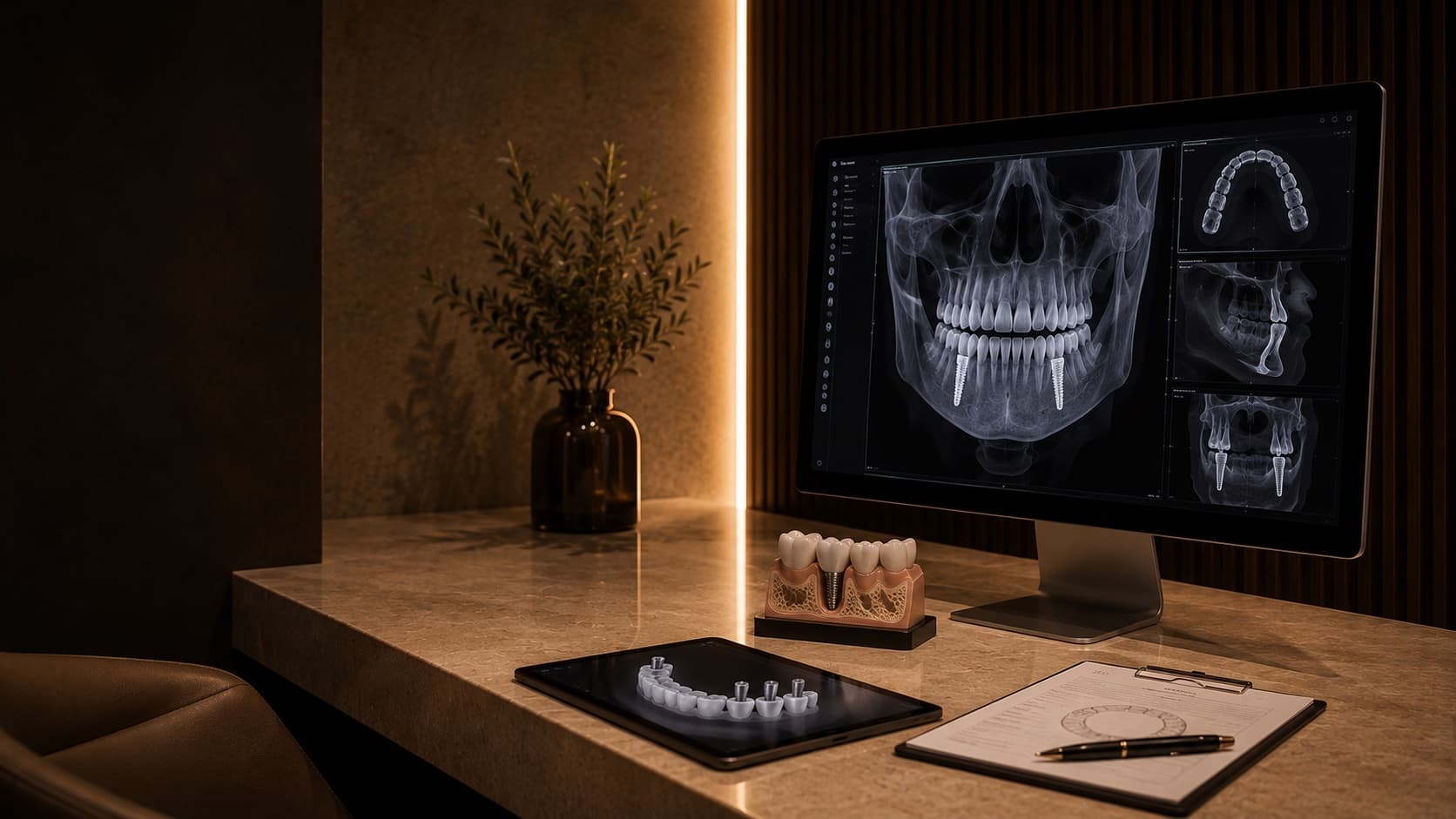
When dental surgery may be needed.
Dental surgery is recommended when an issue can't be solved with routine treatment alone — for example, when a tooth is impacted, bone volume is insufficient for implants, or infection may affect long-term oral health.
- Painful or impacted wisdom teeth
- Tooth decay or fracture beyond restoration
- Bone loss before dental implant placement
- Sinus area requiring support for upper-jaw implants
- Cysts, lesions, or recurring infection
- Pre-implant site preparation or restorative groundwork
Four surgical treatments.
Tap a treatment for what it's used for, how it's planned, and how it's kept comfortable.
- Best for
- Pain, swelling, impacted or partially erupted wisdom teeth, infection risk
- Planning
- Digital X-rays or CBCT to evaluate position, root structure and nerve proximity
- Comfort
- Local anesthesia; laughing gas (nitrous oxide) on request
Ask about wisdom tooth extractionPatient benefits- Minimizes pain and discomfort associated with impacted teeth.
- Reduces the risk of infections, cysts, and damage to adjacent teeth.
- Prevents overcrowding and maintains proper alignment of existing teeth.
- Supports gum health and protects the overall oral environment.
- Enables faster healing with minimal post-operative complications.
- Maintains a comfortable bite and long-term dental function.
- Best for
- Patients planning future implants, delicate roots, bone preservation priority
- Planning
- CBCT to map root and bone anatomy before extraction
- Comfort
- Local anesthesia; gentler than conventional extraction
Ask about atraumatic ultrasonic extractionPatient benefits- Preserves jawbone for future dental implants or restorations.
- Minimizes trauma to gums and surrounding tissues.
- Reduces bleeding, swelling, and post-operative pain.
- Faster recovery compared to traditional extraction methods.
- Safer for delicate or compromised teeth, including roots close to nerves.
- Best for
- Insufficient upper-jaw bone height before implant placement
- Planning
- CBCT to map sinus floor and the graft volume needed
- Comfort
- Local anesthesia or sedation; performed in a private surgical suite
Ask about sinus liftingPatient benefits- Provides sufficient bone height for successful dental implant placement.
- Prevents sinus-related complications with implants.
- Maintains jawbone volume and facial structure.
- Enhances long-term stability and functionality of dental implants.
- Supports natural chewing efficiency and smile aesthetics.
- Best for
- Tooth-loss-related bone resorption, pre-implant site preparation
- Planning
- CBCT to assess bone deficiency and select graft material
- Comfort
- Local anesthesia or sedation; minimally invasive when possible
Ask about bone graftingPatient benefits- Restores bone volume for implant placement or structural support.
- Maintains facial aesthetics and prevents sunken appearance.
- Supports long-term dental health and implant success.
- Minimizes risk of implant failure due to insufficient bone.
- Promotes natural bone regeneration and oral function.
Planned with precision. Performed with care.
At Madeel Dental Center, dental surgery is performed using advanced imaging, precision tools, and minimally invasive techniques to reduce trauma and accelerate healing. Our team of skilled oral surgeons ensures that each procedure is personalized to the patient's needs, combining clinical expertise with the latest technology for predictable, long-lasting results.
Digital planning
CBCT and digital X-rays map tooth position, bone volume, roots, nerves and sinus anatomy before treatment.
Minimally invasive techniques
Where clinically appropriate, ultrasonic and microscope tools reduce trauma, bleeding and healing time.
Comfort-first care
Computer-guided local anesthesia. Laughing gas (nitrous oxide) on request, reviewed against medical history first.
Recovery support
Written post-operative instructions, follow-up visits and a 24-hour direct line.
What to expect, step by step.
- 01
Comprehensive assessment including dental and medical history.
- 02
Advanced imaging (X-rays, CBCT scans) for precise planning.
- 03
Administration of anesthesia or sedation for comfort.
- 04
Surgical procedure performed using minimally invasive techniques.
- 05
Post-operative care instructions and monitoring to ensure proper healing.
- 06
Follow-up visits to evaluate recovery and oral function.
Why timely surgery matters.
Delaying surgical care can let pain, infection, bone loss or implant complications worsen. A precise plan protects long-term oral health and supports future restorative treatment.
- Restores oral function in complex cases.
- Prevents worsening pain, infection or bone loss.
- Supports successful implant placement.
- Preserves bone volume and facial structure.
- Reduces healing time with minimally invasive techniques.
Not sure which treatment you need? Talk to a specialist on WhatsApp →
Common questions.
Direct answers to the questions patients ask before booking — pain, sedation, recovery, and the steps from consultation to result.
No. The area is fully numbed with computer-guided local anesthesia, so most patients don't notice the injection itself. Mild discomfort in the first 24–48 hours is managed with standard pain relief and fades within a day or two.
Yes — awake but completely numb. We use computer-guided local anesthesia for every surgical procedure. If you're anxious, laughing gas (nitrous oxide) is available on request — light, controllable, and wears off within minutes. Every sedation plan is reviewed against your medical history first.
Soft foods the same day, and most patients are back to a light routine the next morning. Pause strenuous activity, swimming, and heavy lifting for two to three days. Sinus lifts and bone grafts take longer to settle than a simple extraction — your written post-operative plan will include the specific timeline for your case.
Simple extractions take 20–30 minutes; surgical wisdom-tooth removal, sinus lifts and bone grafts run 45–90 minutes. With local anesthesia only, you can drive home immediately. If you opt for laughing gas, the effects wear off within minutes — we wait until you're fully clear before you leave.
You leave with a written post-operative plan and a 24-hour direct line. Mild swelling, light bleeding for a few hours, and tenderness are expected. Severe pain, persistent bleeding, or fever past 24 hours are not — message or call us and the clinical team will guide you.
Not always. If a tooth was lost recently and bone volume is good, the site can take an implant directly. If bone has resorbed over time — common after years without a tooth — a graft restores enough volume to place an implant safely. A CBCT scan at the consultation tells us which applies to your case.
Typically four to nine months, depending on the graft size and how quickly your body integrates new bone. Smaller grafts heal faster; larger sinus lifts can take the full nine. We confirm readiness with a follow-up CBCT before placing the implant.
Not necessarily. If they've come in straight, are easy to clean, and aren't damaging neighbouring teeth, they can stay. Removal is the right call when there's pain, swelling, recurring infection, crowding, or imaging that shows impaction or cyst risk. It's easier and quicker to recover from before the roots fully form — but every case is reviewed individually.
The next step is a conversation.
Send a message, share what's going on, and we'll take it from there.
Prefer to call? +971 50 177 9179