
Orthodontics & Braces
Metal, ceramic, Damon self-ligating, or Invisalign — straightened with the system that fits your case.
- Comprehensive Assessment
- Digital Imaging When Needed
- Personalized Treatment Plan
- Transparent Recommendations
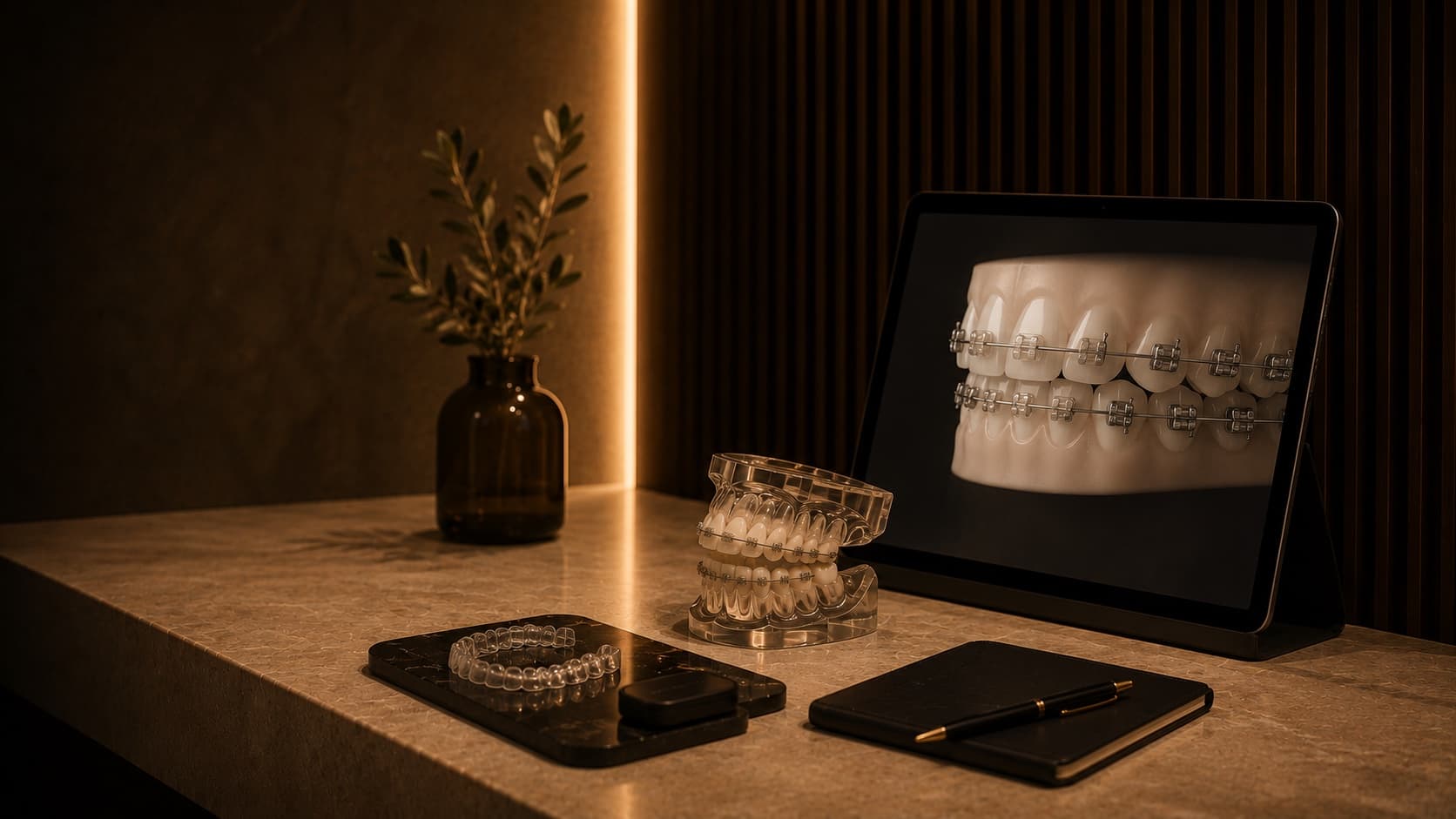
When orthodontics may be needed.
Orthodontic treatment isn't only about appearance. Crowded, crooked, or misaligned teeth are harder to clean, wear unevenly, strain the jaw joint, and can affect chewing and speech. Most cases are easier to treat the earlier they're addressed — but adult orthodontics is now routine and aesthetic options have made it almost invisible.
- Crowded, overlapping, or crooked teeth
- Gaps or spacing between teeth
- Overbite, underbite, crossbite, or open bite
- Jaw discomfort or uneven tooth wear from a bad bite
- Relapse after previous orthodontic treatment
- Children with developing alignment issues identified at routine check-ups
Four orthodontic options.
Tap a treatment for what it's used for, how it's planned, and how it's kept comfortable.
- Best for
- Adults and teens wanting discreet treatment; mild to moderately complex cases of crowding, spacing, or bite issues
- Planning
- 3D digital scan with treatment simulation; full aligner series fabricated in advance
- Comfort
- No brackets or wires — aligners are smooth and removable
Ask about invisalign & clear alignersPatient benefits- Nearly invisible — most people won't notice you're wearing them.
- Removable for eating, brushing, and flossing — no diet restrictions.
- Effective for crowding, spacing, and most bite issues.
- Fewer in-office visits than traditional braces.
- Predictable result — the plan is visible upfront in 3D.
- Best for
- Severe crowding, complex bite issues, children and teens, patients prioritizing cost over aesthetics
- Planning
- 3D digital scan, panoramic X-ray, and bite analysis before placement
- Comfort
- Mild soreness for 2–3 days after placement and each adjustment
Ask about metal bracesPatient benefits- Most effective system for severe alignment and bite issues.
- Durable and strong — handles complex tooth movements predictably.
- Typically the most affordable orthodontic option.
- Always working — no risk of the patient forgetting to wear them.
- Decades of clinical evidence behind the system.
- Best for
- Teens and adults wanting effective bracket-based treatment without the visible metal
- Planning
- 3D digital scan and bite analysis before placement
- Comfort
- Similar to metal braces — mild soreness after placement and adjustments
Ask about ceramic bracesPatient benefits- Far less visible than metal — tooth-colored or clear brackets blend in.
- Same effectiveness as metal braces for most cases.
- Biocompatible and well tolerated.
- Predictable results backed by clinical evidence.
- Good middle ground between metal braces and Invisalign.
- Best for
- Patients wanting bracket-based treatment with fewer in-office visits; available in metal or clear ceramic
- Planning
- 3D digital scan, X-rays, and bite analysis
- Comfort
- Reportedly less soreness than traditional braces due to lower friction
Ask about damon self-ligating bracesPatient benefits- Lower friction — teeth move with gentler forces.
- Fewer in-office adjustments than traditional braces.
- Often shorter overall treatment time.
- Available in clear ceramic for a more discreet look.
- Easier to clean — no elastic ties to trap plaque.
Planned with precision. Performed with care.
We start with a full orthodontic evaluation — 3D digital scan, panoramic X-ray, bite analysis, and a conversation about what matters to you. We explain which systems would work for your case, the trade-offs of each, and the realistic timeline. For children, we watch jaw and bite development from age seven so any intervention happens at the easiest time. For adults, we lean toward Invisalign or ceramic braces when the case allows.
Digital 3D planning
Every orthodontic case begins with a 3D digital scan of your teeth and bite. The scan replaces the old putty impressions and lets us plan tooth movement on screen before any brackets or aligners are placed.
Right system for the case
Not every patient needs the same system. Severe crowding and bite issues may respond best to traditional braces. Aesthetic cases favor Invisalign or ceramic. Faster treatment with fewer visits points to Damon self-ligating. We recommend based on your bite, not based on what we want to sell.
Fewer visits where possible
Damon self-ligating braces and Invisalign both reduce in-office time compared to traditional braces. Adjustments are faster and less frequent.
Retention is part of the plan
Teeth move back if they're not held in place. Every treatment ends with a retainer — fixed, removable, or both — and a plan for keeping the result long-term.
What to expect, step by step.
- 01
Comprehensive evaluation — 3D digital scan, panoramic X-ray, bite analysis, and photos.
- 02
Treatment options reviewed — metal, ceramic, Damon, or Invisalign — with realistic timelines.
- 03
Personalized plan and digital preview of expected tooth movement.
- 04
Placement of braces or fitting of first set of aligners.
- 05
Regular adjustments — every 4–6 weeks for braces, aligner changes every 1–2 weeks.
- 06
Retention phase — fixed or removable retainer to hold the result long-term.
Why straight teeth matter beyond appearance.
Crowded teeth trap plaque and are harder to clean. A bad bite wears teeth unevenly and strains the jaw joint. Orthodontics fixes the alignment, but the bigger payoff is decades of easier daily care and less wear and tear on your bite.
- Straightens teeth and corrects bite issues that affect chewing and jaw comfort.
- Makes daily cleaning easier — straight teeth are easier to brush and floss.
- Reduces uneven tooth wear and the risk of cracked teeth from a bad bite.
- Improves smile appearance and confidence.
- Treats children, teens, and adults — there's no age cut-off for orthodontics.
Not sure which treatment you need? Talk to a specialist on WhatsApp →
Common questions.
Direct answers to the questions patients ask before booking — pain, sedation, recovery, and the steps from consultation to result.
Most cases run twelve to twenty-four months. Mild crowding or spacing with Invisalign can finish in as little as six to twelve months. Complex bite issues with metal braces may take twenty-four months or more. We give you a realistic timeline at the consultation, based on a 3D scan of your bite.
No. Orthodontics works at any age because teeth can be moved at any age — the biological process is the same in a thirty-year-old as in a teenager. Adult orthodontics is one of the fastest-growing parts of the field, and Invisalign and ceramic braces have made it almost invisible.
It depends on the case. Invisalign is excellent for mild to moderate crowding, spacing, and most bite issues, and it's nearly invisible. Traditional or self-ligating braces handle severe crowding and complex bite problems more predictably. At the consultation we tell you what works for your specific bite — not just what's popular.
There's mild soreness for two to three days after braces are first placed and after each adjustment, and similar mild pressure when you switch to a new Invisalign tray. Over-the-counter pain relief is enough for most patients. After the first few days you stop noticing them.
Yes — you take the aligners out to eat. There are no food restrictions. With braces, you avoid sticky, hard, and chewy foods that can damage brackets — popcorn, hard candy, gum, ice. Most other foods are fine.
Yes. Teeth shift over time if nothing is holding them. Every patient ends treatment with a retainer — fixed behind the front teeth, removable for night-time wear, or both. Retention is part of the result, not optional.
Metal and ceramic braces: every four to six weeks. Damon self-ligating: every six to eight weeks. Invisalign: every six to eight weeks for a progress check, with aligner changes happening at home every one to two weeks.
Children should have an orthodontic evaluation by age seven. Most do not start treatment that early — but some bite or jaw issues are easier to correct while the jaw is still growing. We monitor at every six-month visit and start treatment when the timing is right for the specific issue.
The next step is a conversation.
Send a message, share what's going on, and we'll take it from there.
Prefer to call? +971 50 177 9179