
Dental Implants
Single, immediate, 3D-guided and full-arch implants — planned virtually, placed with precision.
- Comprehensive Assessment
- Digital Imaging When Needed
- Personalized Treatment Plan
- Transparent Recommendations
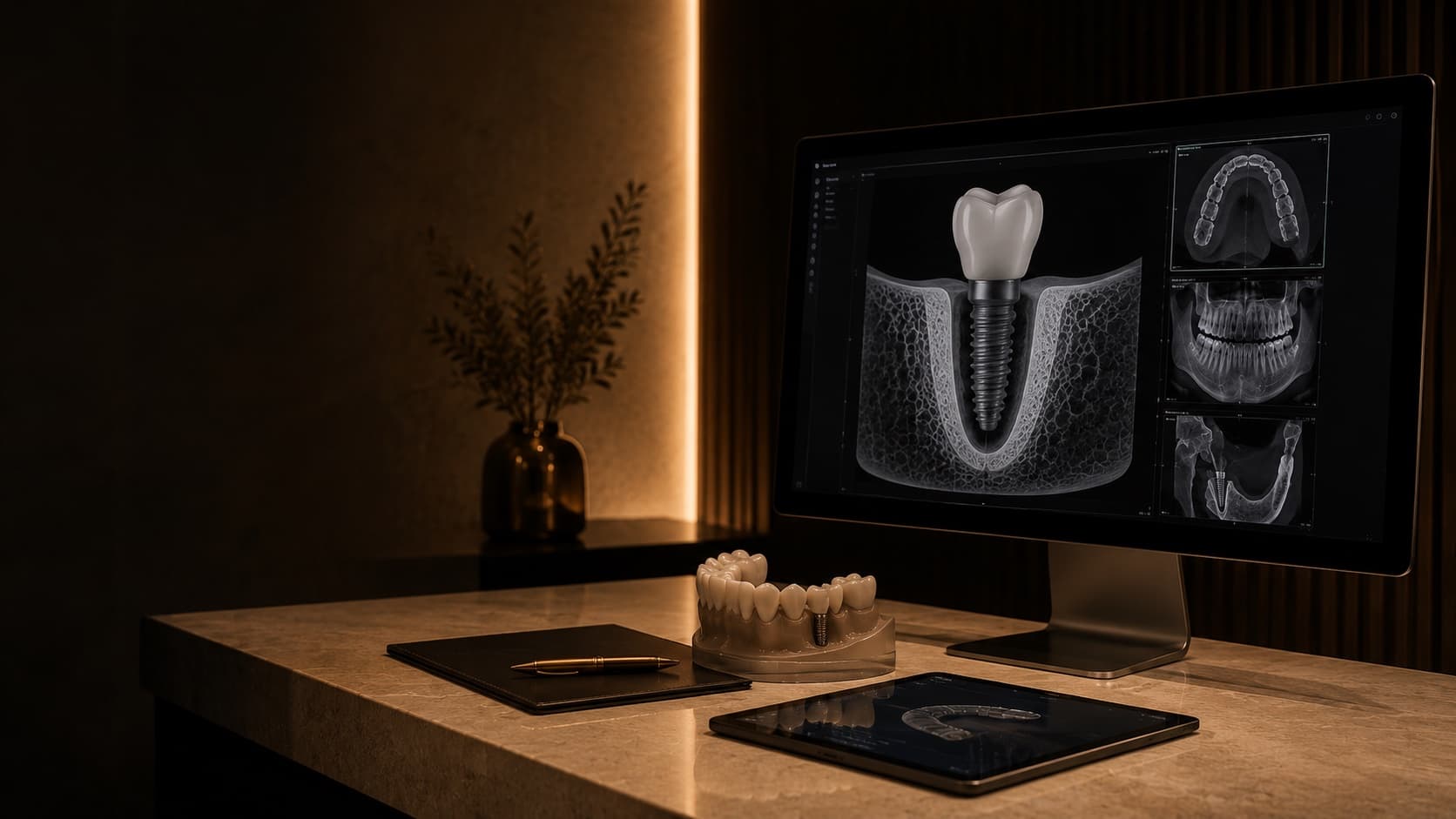
When implants may be needed.
Implants are the right choice when one or more teeth are missing, failing, or beyond restoration — and the goal is a fixed replacement that looks and functions like a natural tooth.
- One or more missing teeth, front or back
- A tooth recently lost to extraction or trauma
- A failing bridge or denture causing discomfort
- Multiple teeth missing across an entire arch
- Bone preservation after tooth loss
- Replacing a removable denture with a fixed solution
Six implant options.
Tap a treatment for what it's used for, how it's planned, and how it's kept comfortable.
- Best for
- Recently extracted teeth, good bone volume, preference for fewer visits
- Planning
- CBCT to confirm bone density and socket geometry before placement
- Comfort
- Local anesthesia; laughing gas on request
Ask about immediate dental implantsPatient benefits- Preserves natural bone density and gum shape at the extraction site.
- Reduces overall treatment time and number of visits.
- Minimizes surgical trauma — one procedure instead of two.
- Restores smile aesthetics and chewing function quickly.
- Supports long-term implant success and comfort.
- Best for
- Complex anatomy, proximity to nerves or sinuses, predictable aesthetic cases
- Planning
- CBCT + intraoral scan + virtual placement, then a custom surgical guide is fabricated
- Comfort
- Local anesthesia; minimal incisions reduce healing time
Ask about 3d guided dental implantsPatient benefits- Highly accurate placement, reducing risk to nerves and sinuses.
- Minimal incisions, less swelling, and faster recovery.
- Predictable aesthetic and functional results.
- Shorter surgical time with fewer complications.
- Long-term stability and precise prosthetic alignment.
- Best for
- Eligible cases with adequate bone density, patients prioritising minimal downtime
- Planning
- CBCT confirms primary stability before same-day loading
- Comfort
- Local anesthesia; sedation available on request
Ask about same-day dental implantsPatient benefits- Immediate restoration of your smile in a single visit.
- No need for removable temporary dentures or bridges.
- Shorter overall treatment time with fewer clinic visits.
- Improved comfort, confidence, and natural appearance from day one.
- Precise, stable results using advanced digital planning.
- Best for
- Multiple missing teeth across an entire arch, denture replacement
- Planning
- CBCT mapping of bone availability across the full arch
- Comfort
- Local anesthesia or sedation; performed in a private surgical suite
Ask about full arch dental implantsPatient benefits- Restores natural chewing function across the whole arch.
- Prevents jawbone deterioration after tooth loss.
- Provides fixed, stable teeth — no denture movement.
- Improves facial structure and smile aesthetics.
- Long-lasting, durable solution for multiple missing teeth.
- Best for
- Reduced bone density, denture wearers seeking a fixed solution
- Planning
- CBCT assessment of bone for angled posterior implant placement
- Comfort
- Local anesthesia or sedation on request
Ask about all-on-4 dental implantsPatient benefits- Avoids bone grafting in many cases.
- Immediate function with fixed teeth in suitable candidates.
- Reduced surgical complexity and faster recovery.
- Strong, stable foundation for a full arch.
- Cost-effective solution for multiple missing teeth.
- Best for
- Higher bite forces, maximum durability priority, sufficient bone for six implants
- Planning
- CBCT analysis of bite forces and bone availability across the arch
- Comfort
- Local anesthesia or sedation on request
Ask about all-on-6 dental implantsPatient benefits- Superior support and chewing efficiency under high bite forces.
- Improved long-term implant survival rates vs four-implant configurations.
- Optimal load distribution across the jaw.
- Natural appearance and function.
- Long-lasting, durable solution for a complete arch.
Planned with precision. Performed with care.
Every implant at Madeel begins with a CBCT 3D scan and an intraoral impression. The CBCT shows bone, nerves, and sinus floor at sub-millimetre resolution; the intraoral scan models the bite. From these two scans, your implant is virtually placed inside a model of your jaw — long before any instrument is picked up.
Digital planning
CBCT 3D imaging and intraoral scans map your jaw and bite. Implants are placed virtually inside a model of your mouth before any instrument is used.
3D-guided placement
Custom surgical guides translate the digital plan into a precise physical placement — avoiding nerves and sinuses, predictable angles, stable foundations.
Premium materials
Biocompatible titanium implants and custom-milled prosthetic crowns. Each component is selected for the specific case, not pulled from a shelf.
Long-term follow-up
Osseointegration monitored over weeks. Follow-up visits confirm the implant has settled before the final restoration is fitted.
What to expect, step by step.
- 01
Comprehensive consultation with CBCT 3D scan and intraoral impressions.
- 02
Virtual planning — implant placement modeled digitally inside your jaw.
- 03
Custom surgical guide fabricated for precise placement.
- 04
Implant placement under local anesthesia, with sedation on request.
- 05
Healing phase — osseointegration over several weeks.
- 06
Final restoration — custom crown, bridge, or full-arch prosthesis fitted.
Why implants over bridges or dentures.
An implant replaces the tooth root, not just the visible crown. That preserves the jawbone underneath, maintains facial structure, and gives a fixed, stable bite — none of which a bridge or removable denture can match.
- Restores natural chewing function and smile aesthetics.
- Preserves jawbone and prevents resorption after tooth loss.
- Supports facial structure and prevents the sunken look that follows missing teeth.
- Fixed and stable — no movement, slippage, or click of a denture.
- Long-lasting — decades of use with proper care.
Not sure which treatment you need? Talk to a specialist on WhatsApp →
Common questions.
Direct answers to the questions patients ask before booking — pain, sedation, recovery, and the steps from consultation to result.
With proper care, decades. The implant fixture in the bone often lasts a lifetime — many implants placed in the 1980s are still in function. The crown or bridge on top may need replacement after 10–15 years from normal wear, but the implant itself is a long-term restoration.
No. The procedure is done under computer-guided local anesthesia — most patients don't even notice the injection. Mild swelling or discomfort for 24–48 hours after placement is normal and managed with standard pain relief.
Not always. If a tooth was lost recently and bone volume is good, the implant can go in directly. If bone has resorbed over time — common after years without a tooth — a graft restores enough volume to place the implant safely. A CBCT scan at consultation tells us which applies to your case.
Immediate placement is possible on the same day if bone volume and socket geometry support it. Otherwise, a healing phase of three to six months precedes placement, depending on how the bone reshapes. The CBCT at extraction determines which path is right.
Typically three to six months from placement to final crown — most of that is osseointegration (the bone fusing to the implant). Same-day temporary restorations are available for eligible cases, but the final permanent crown still waits for healing to complete.
All-on-4 uses four implants per arch, often avoiding bone grafting via angled posterior placement. All-on-6 uses six, distributing chewing forces more evenly — better for higher bite forces or maximum long-term durability. The choice depends on bone availability and your case, confirmed by CBCT.
Local anesthesia is standard and sufficient for most implant placements — you stay awake but feel nothing. If you're anxious, laughing gas (nitrous oxide) is available on request — light, controllable, wears off within minutes.
Yes. Custom-milled crowns are matched to the shade, shape, and contour of your existing teeth. Once placed and healed, an implant is visually indistinguishable from a natural tooth.
The next step is a conversation.
Send a message, share what's going on, and we'll take it from there.
Prefer to call? +971 50 177 9179