
Restorative & Aesthetic Dentistry
Composite, veneers, crowns and full mouth rehabilitation — function and appearance, together.
- Comprehensive Assessment
- Digital Imaging When Needed
- Personalized Treatment Plan
- Transparent Recommendations
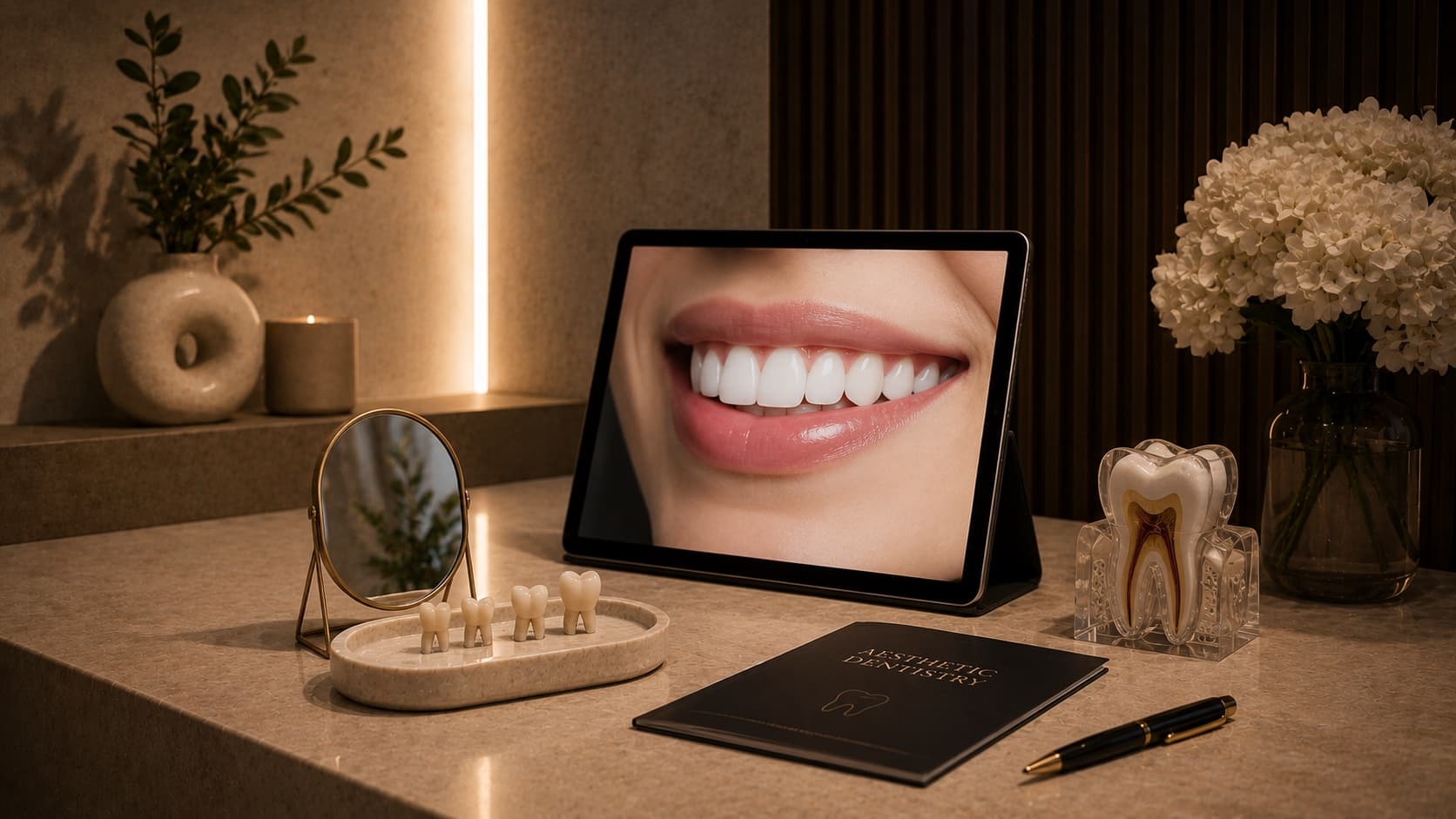
When restorative work is the right call.
Restorative dentistry covers everything from a single filling to a full rehabilitation of the bite. The right treatment depends on how much of the tooth is missing, how the bite is loaded, and what you want the result to look like.
- A cavity that has grown beyond what a simple filling can hold
- A chipped, cracked or worn-down tooth
- An old silver amalgam filling you want replaced
- Discoloured, stained or short front teeth
- Gaps between front teeth you want closed without braces
- Severely worn or broken teeth from grinding (bruxism)
Four restorative treatments.
Tap a treatment for what it's used for, how it's planned, and how it's kept comfortable.
- Best for
- Small to medium cavities, chipped edges, gap closure, replacing old amalgam, reshaping front teeth
- Planning
- Shade match against adjacent teeth, photographs for chairside design
- Comfort
- Local anesthesia for cavities; bonding-only cases often need none
Ask about composite bondingPatient benefits- Most conservative restoration — minimal enamel removed.
- Completed in a single visit.
- Shade-matched and invisible against natural teeth.
- Repairs chips, closes small gaps and replaces old fillings.
- Lower cost than veneers or crowns.
- Best for
- Discoloured front teeth, chipped edges, small gaps, short or worn-down teeth, smile makeovers
- Planning
- Digital Smile Design simulation, try-in step before final bonding
- Comfort
- Local anesthesia for preparation appointment; final bonding visit is comfortable without
Ask about porcelain veneersPatient benefits- Highly natural appearance — porcelain mimics enamel translucency.
- Stain-resistant against coffee, tea and tobacco.
- Lasts 10–15 years with normal care.
- Minimal enamel preparation.
- Corrects shape, shade and minor alignment in one treatment.
- Best for
- Heavily broken-down teeth, root-treated teeth, large cavities beyond a filling, fractured cusps
- Planning
- Digital scan and bite registration; design and milling done in-house
- Comfort
- Local anesthesia; full restoration delivered the same appointment
Ask about same-day crowns, inlays & onlaysPatient benefits- Completed in a single visit for most cases.
- No temporary crown and no second appointment.
- Onlay option preserves more natural tooth than a full crown.
- Strong, stain-resistant ceramic.
- Designed against your actual bite, in-house.
- Best for
- Severe grinding wear, multiple missing teeth, collapsed bite, extensive decay across several teeth, TMJ pain from bite issues
- Planning
- CBCT, full digital scan, bite analysis, Digital Smile Design, coordinated treatment plan
- Comfort
- Phased over weeks to months depending on case complexity
Ask about full mouth rehabilitationPatient benefits- Restores chewing, speech and facial support together.
- Resolves bite-related jaw pain and TMJ discomfort.
- Coordinated plan instead of a tooth-at-a-time approach.
- Aesthetics planned from the start, not bolted on at the end.
- Long-term protection against further wear.
Planned with precision. Performed with care.
Every restorative case at Madeel starts with a digital scan and a bite analysis. For aesthetic cases we use Digital Smile Design — a simulation of the proposed result on a photograph of your face, so you can adjust shape and shade before fabrication begins. Crowns and onlays are designed and milled the same day where the case allows. Veneers are crafted in the lab over 2–3 visits with a try-in step before final bonding. Old mercury amalgam fillings are removed under rubber dam with high-volume suction.
Minimally invasive
We remove only the damaged structure and preserve as much natural enamel as possible. Composite bonding instead of crowns when the tooth allows it, onlays instead of full-coverage crowns when there is enough healthy structure to bond to.
Digital from start to finish
Intra-oral scans replace impression trays. Digital Smile Design lets you see the proposed result before any tooth is touched. Same-day crowns are designed and milled in-house.
Material chosen for the tooth
Composite resin for small cavities and bonding. E.max and porcelain veneers for front teeth where translucency matters. Zirconia for back teeth that take heavy bite force. The material follows the case, not a default.
Planned with the bite
Every crown, onlay and veneer is designed against your actual occlusion. We adjust for grinding habits and TMJ load before the restoration goes in — not after.
What to expect, step by step.
- 01
Consultation and clinical exam.
- 02
Digital intra-oral scan and bite analysis.
- 03
Digital Smile Design for aesthetic cases — preview before any prep.
- 04
Conservative preparation under local anesthesia.
- 05
Restoration placement: composite, milled crown, lab-fabricated veneer or onlay.
- 06
Bonding, polishing and bite adjustment.
- 07
Review appointment to confirm fit, function and finish.
Why a planned restoration beats a quick fix.
A filling that is too big, a crown that does not match the bite, or a veneer rushed without smile design all fail the same way — they look or feel off, and they fail early. A digitally planned restoration costs more upfront and lasts considerably longer.
- Repairs damage with minimal removal of healthy enamel.
- Restorations colour-matched to your natural teeth.
- Single-visit crowns where the case allows.
- Old silver fillings replaced with tooth-coloured bonded composite.
- Veneers correct shape, shade and minor alignment without braces.
- Stain-resistant porcelain that holds its colour long-term.
Not sure which treatment you need? Talk to a specialist on WhatsApp →
Common questions.
Direct answers to the questions patients ask before booking — pain, sedation, recovery, and the steps from consultation to result.
With normal care, porcelain veneers last 10 to 15 years. A few patients get longer. The two things that shorten their life are grinding without a night guard, and biting hard objects like pens or fingernails.
They should not. Porcelain has a translucency that lets light pass through the way natural enamel does. The most common reason veneers look fake is shade chosen too white for the patient's face, which is why we run a Digital Smile Design simulation before any prep.
Yes. We use Digital Smile Design — a simulation on a photograph of your face — so you can review the shape, shade and proportions of the proposed result before any tooth is prepared.
For most back teeth a same-day milled crown is excellent and saves a second visit. For front teeth where shade nuance and layered translucency matter, a lab-fabricated crown over two visits usually gives a better result. We'll tell you which suits your case.
Most amalgam fillings sit safely for years and are not an active risk. Patients usually replace them for one of two reasons — the filling has cracked or started to leak, or they prefer the appearance of tooth-coloured composite. We remove them under rubber dam with high-volume suction.
Anywhere from a few months to over a year, depending on how much work is needed and whether implants are part of the plan. We sequence the work so you have functioning teeth the whole way through — there is no long period without working teeth.
On a restoration that respects your existing bite, no — it should feel like your own tooth within a day or two. On a full mouth rehabilitation that intentionally changes the bite, there is an adjustment period of one to two weeks.
Whitening only works on natural enamel. Veneers and crowns hold their colour and do not respond to bleaching. If you want a brighter smile, whiten first and match the veneer or crown shade to the result.
The next step is a conversation.
Send a message, share what's going on, and we'll take it from there.
Prefer to call? +971 50 177 9179